
By: VOG News Desk
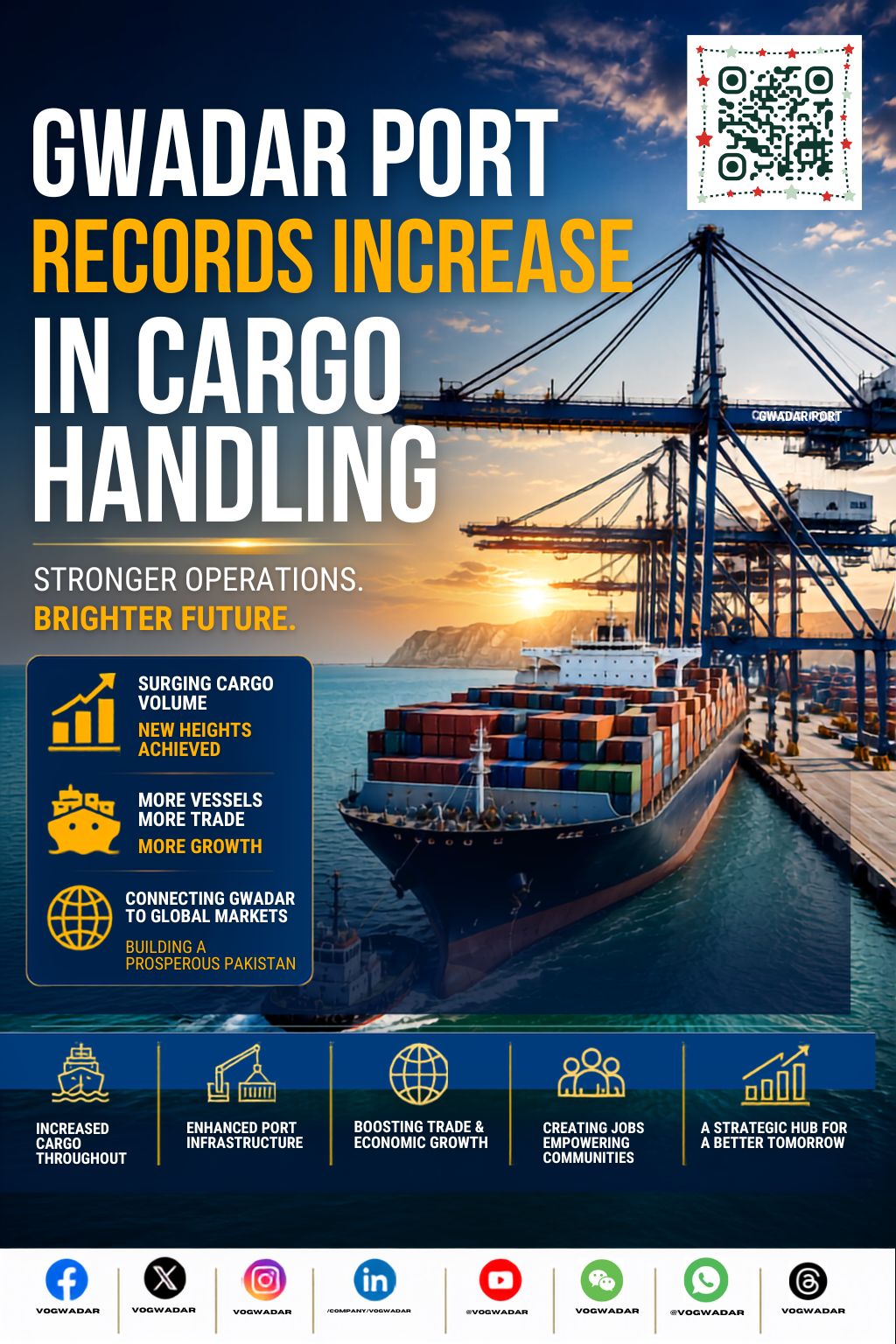
Gwadar Port is entering a new phase of commercial activity, with recent months showing a marked rise in cargo volumes, vessel traffic, and transshipment operations. What was once described as a port still finding its commercial footing is now being spoken of by officials and shipping industry figures as an active, functioning trade hub.
Several large vessels have berthed at Gwadar in recent weeks, each carrying substantial cargo loads. One notable arrival involved a deep-draft ship originating from China, which offloaded tens of thousands of tonnes of steel material bound for onward shipment to Oman. The vessel’s size and draft were seen as a test of the port’s technical capacity, and its successful handling was viewed as proof that Gwadar can now accommodate larger international cargo ships rather than smaller regional traffic alone. Other vessels arriving around the same period brought general cargo, machinery, and bulk fertilizer shipments, adding to the port’s growing list of commercial transactions.
Port officials attribute part of this rise to shifting global shipping patterns. Tensions around the Strait of Hormuz and broader instability affecting Gulf shipping routes have pushed several international carriers to look for alternative docking points that offer both safety and cost advantages. Gwadar, positioned close to this critical corridor but outside its most contested waters, has increasingly been mentioned as a viable alternative for transshipment cargo, particularly for goods moving between China, the Middle East, and Central Asia.
Free storage incentives offered within the Gwadar Free Zone have also played a role in attracting shipping lines. By reducing turnaround costs for operators, the port has positioned itself as more competitive against established regional hubs. Officials have pointed out that the port’s container-handling capacity, along with its general cargo storage space, is now being put to active use rather than sitting idle, which had long been a criticism of the facility during its earlier years of development.
Beyond individual vessel arrivals, container transshipment figures have also picked up sharply. Monthly transit volumes have moved from a few thousand containers to figures in the tens of thousands, a jump that industry observers describe as unusually fast even by the standards of an emerging port. This has renewed conversations about Gwadar’s long-term role within the China-Pakistan Economic Corridor, shifting the narrative from a project still under construction to one that is beginning to generate measurable trade activity.
Infrastructure upgrades connected to the port, including improved road access, water supply arrangements, and airport connectivity nearby, are being cited as supporting factors behind this uptick. However, officials and analysts alike caution that sustaining this momentum will require continued investment, particularly in attracting local industry to generate a steady cargo base rather than relying solely on the current wave of route diversions caused by regional tensions.
For now, though, the numbers point in a positive direction. Gwadar’s recent cargo handling activity marks one of its strongest stretches yet, and if maintained, could mark a genuine turning point in the port’s transition from a long-anticipated project to a functioning link in regional and international trade.