
By: VOG News Desk
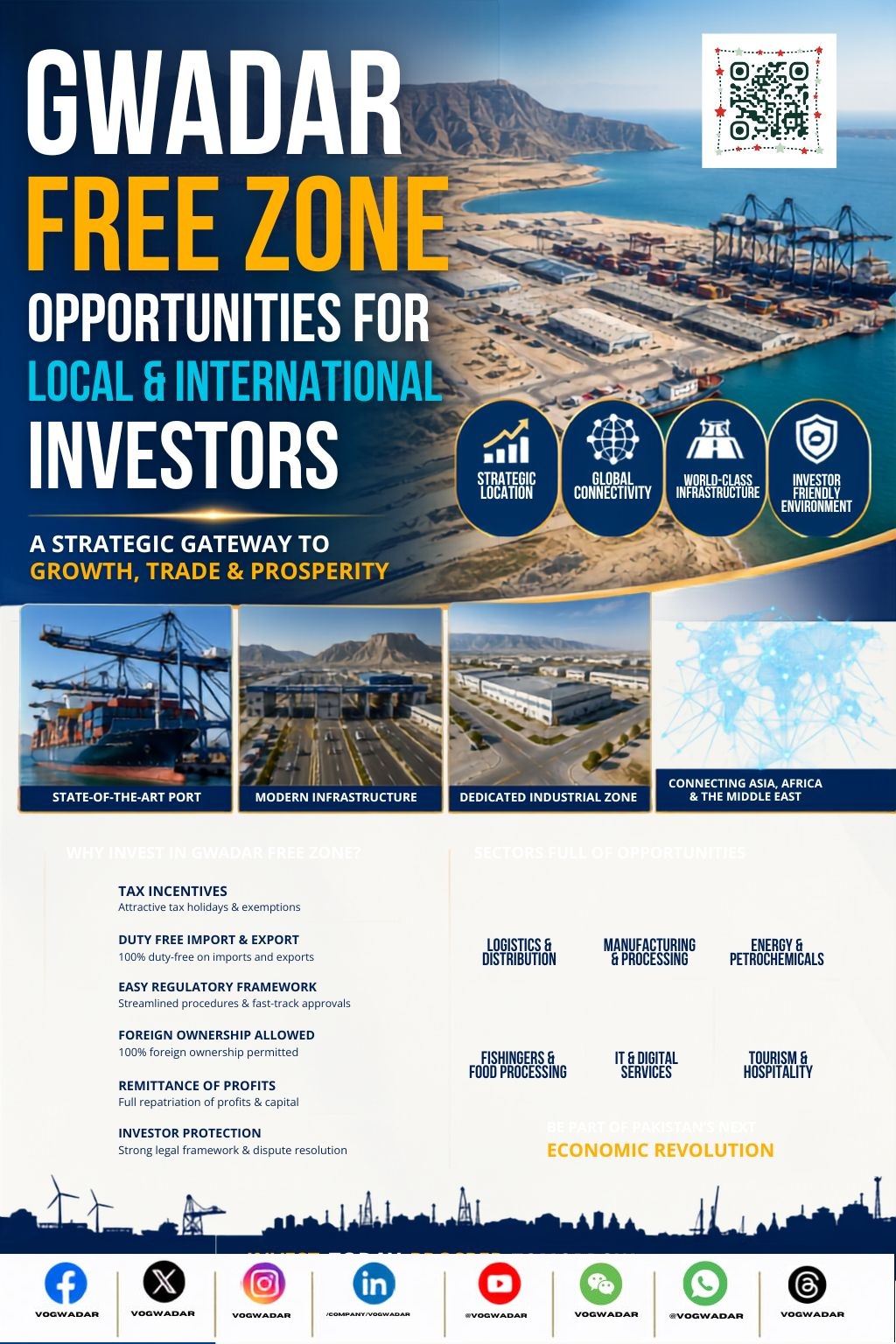
Among the various components of the China-Pakistan Economic Corridor, the Gwadar Free Zone has quietly become one of the most attractive propositions for investors looking to enter Pakistan’s trade and industrial landscape. Spread across a substantial stretch of land adjacent to Gwadar Port, the zone was designed specifically to draw businesses in manufacturing, logistics, warehousing, and trade-related services, offering conditions that are difficult to match elsewhere in the region.
The core appeal for investors lies in the fiscal incentives attached to the zone. Businesses operating within its boundaries benefit from a lengthy income tax holiday extending over two decades, along with exemptions on sales tax and customs duties for equipment and materials brought in for construction or operations. Profits earned within the free zone can also be repatriated in full, a detail that matters greatly to foreign investors wary of capital restrictions. For companies relying on imported machinery or raw materials unavailable locally, the ability to bring these in without duty charges significantly lowers the cost of establishing operations.
Beyond the paperwork and tax structure, the physical infrastructure inside the zone has matured considerably. Power supply, water connections, road access, telecommunications, and waste management systems have all been completed in the initial development area, removing many of the practical hurdles that once discouraged businesses from setting up there. A number of enterprises spanning banking, insurance, warehousing, fisheries processing, edible oil production, furniture manufacturing, and even electric vehicle assembly have already registered within the zone, giving it a genuinely mixed industrial character rather than relying on a single sector.
The timing also works in the zone’s favor. Shipping patterns across the wider region have been shifting, with vessels increasingly rerouting toward Gwadar as tensions around traditional Gulf shipping lanes persist. This has translated into rising cargo volumes at the adjacent port, giving businesses inside the free zone direct access to a facility that is no longer operating at a fraction of its capacity. Warehousing, cold storage, and logistics-based businesses in particular stand to benefit from this uptick, since goods moving through the port increasingly require handling, storage, or onward distribution support that the free zone is positioned to provide.
Real estate tied to the surrounding city has also seen steady appreciation, driven by continued infrastructure spending on roads, the international airport, and water supply projects. For investors thinking beyond pure industrial use, this broader development creates secondary opportunities in property and commercial space.
That said, the zone is not without its challenges. Reports from planning bodies have pointed out that while short-term cargo activity is rising, the port and its surrounding free zone still need a more consistent industrial base rather than depending heavily on temporary shifts in global shipping routes. Utilities such as reliable electricity and water in some areas remain a work in progress, even as core infrastructure in the pilot zone has been completed.
For local entrepreneurs, the Gwadar Free Zone offers a rare chance to participate early in a project still building its commercial identity, while international investors gain access to a tax-friendly base positioned at the crossroads of South Asia, the Middle East, and Central Asia. Whether that promise fully materializes will depend on how consistently Pakistan can convert this current wave of interest into long-term industrial activity.