By Sardar Shoukat Popalzai
President, Balochistan Economic Forum
The successful diplomatic settlement between the United States and the Islamic Republic of Iran marks a major geopolitical turning point for the broader region. Beyond reducing the risk of military escalation and restoring confidence in global energy markets, the agreement has created a historic economic opening for Pakistan.
Among all provinces, Balochistan stands to emerge as the principal beneficiary owing to its unique geography, abundant mineral wealth, strategic coastline, proximity to Iran and Afghanistan, and central role within the China-Pakistan Economic Corridor (CPEC).
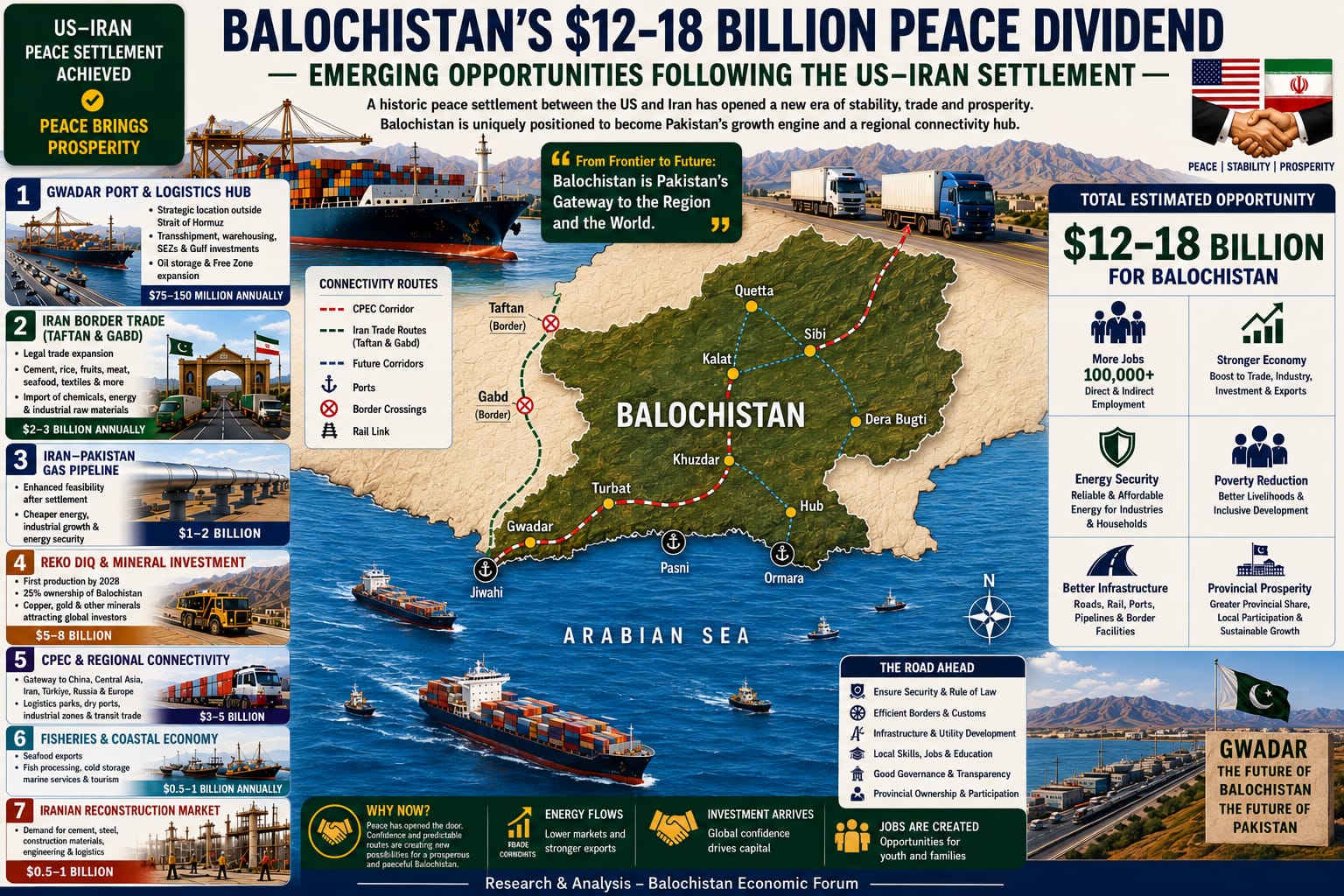
With the reopening of maritime trade routes, declining energy prices, improved investor confidence and the gradual normalization of Iran’s external economic relations, Balochistan is positioned to capture an estimated $12-18 billion in direct and indirect economic opportunities over the coming years.
1. Gwadar Port: Strategic Importance Strengthened
Although the Strait of Hormuz has reopened, the recent crisis demonstrated the vulnerability of global energy supply chains and highlighted the need for alternative logistics hubs.
Located outside the Hormuz chokepoint, Gwadar Port has emerged as a strategic insurance asset for Gulf states, China and regional trade partners.
Expected Benefits:
– Expansion of Gwadar Free Zone.
– Growth in transshipment and warehousing.
– Potential Saudi oil storage facilities.
– Increased shipping and logistics activity.
– Development of Special Economic Zones.
Estimated Opportunity:
US$75-150 million annually
2. Pakistan-Iran Border Trade Expansion
The settlement creates favorable conditions for expanding legal trade through:
– Taftan Border Crossing.
– Gabd-Rimdan Border Terminal.
– Mand-Pishin border markets.
– Transit trade routes linking Gwadar and Iran.
Major Export Opportunities:
From Balochistan and Pakistan to Iran:
– Cement.
– Rice.
– Fruits and vegetables.
– Meat and livestock products.
– Seafood.
– Textile products.
– Construction materials.
Imports from Iran:
– Petrochemicals.
– Chemicals.
– Energy products.
– Industrial raw materials.
Estimated Opportunity:
US$2-3 billion annually
3. Iran-Pakistan Gas Pipeline Becomes More Feasible
The post-settlement environment significantly improves the prospects of completing the Iran-Pakistan Gas Pipeline.
The Iranian section was completed in 2013, while Pakistan has already approved the initial section from the Iranian border to Gwadar.
Completion of the project would:
– Reduce energy costs.
– Support industrialization.
– Strengthen energy security.
– Promote new investments in Hub, Lasbela, Gwadar and Turbat.
Estimated Economic Impact:
US$1-2 billion
4. Reko Diq and Mineral Investment Momentum
Balochistan’s mineral sector remains its greatest long-term economic asset.
With improved regional stability and stronger investor confidence, projects such as:
– Reko Diq Copper-Gold Project.
– Saindak.
– Rare Earth Elements.
– Antimony.
– Precious Stones.
– Copper and Chromite deposits.
are expected to attract additional foreign investment.
Key Facts:
– First production at Reko Diq expected in 2028.
– Balochistan retains a 25 percent share.
– Project life exceeds 37 years.
Estimated Investment Impact:
US$5-8 billion
5. CPEC and Regional Connectivity
The normalization of relations with Iran strengthens Balochistan’s role as the gateway connecting:
– China.
– Central Asia.
– Iran.
– Türkiye.
– Russia.
– Europe.
– Gulf States.
Enhanced connectivity can stimulate:
– Dry ports.
– Industrial estates.
– Logistics parks.
– Mineral stockpiles.
– Transportation services.
Estimated Opportunity:
US$3-5 billion
6. Fisheries and Coastal Economy
The coastal belt comprising:
– Gwadar.
– Pasni.
– Ormara.
– Jiwani.
possesses enormous potential for:
– Seafood exports.
– Cold storage facilities.
– Fish processing industries.
– Marine services.
– Coastal tourism.
Estimated Opportunity:
US$500 million 1 billion annually
7. Iranian Reconstruction Market
The post-conflict rebuilding process inside Iran presents new opportunities for Balochistan and Pakistan.
Potential exports include:
– Cement.
– Steel.
– Construction materials.
– Engineering services.
– Transport and logistics support.
Estimated Opportunity:
US$500 million-1 billion
ESTIMATED BALOCHISTAN PEACE DIVIDEND
Sector & Estimated Value
● Gwadar Port & Logistics US$75-150 million
● Pakistan-Iran Trade US$2-3 billion
● Iran-Pakistan Gas Pipeline| US$1-2 billion
● Mineral Investment US$5-8 billion
● CPEC & Regional Transit US$3-5 billion
● Fisheries & Coastal Economy US$0.5-1 billion
● Iranian Reconstruction Market US$0.5-1 billion
Total Estimated Opportunity
US$12–18 Billion
CHALLENGES REMAIN
While interstate tensions may have eased, economic transformation requires:
– Sustained peace and stability.
– Improved security environment.
– Efficient customs and border management.
– Infrastructure development.
– Greater provincial participation.
– Human resource development.
– Transparent governance and local ownership.
CONCLUSION
For decades, Balochistan’s strategic location has been viewed primarily through a security lens. The post-US-Iran settlement environment presents an opportunity to redefine the province as:
A Regional Trade Gateway.
An Energy Corridor.
A Mineral Powerhouse.
A Maritime Hub.
A Bridge Between South Asia, Central Asia and the Middle East.
If managed effectively, the emerging geopolitical landscape could transform Balochistan from a peripheral province into one of the most important economic regions of Pakistan and the wider region. -Ends-
Research & Analysis – Balochistan Economic Forum.